
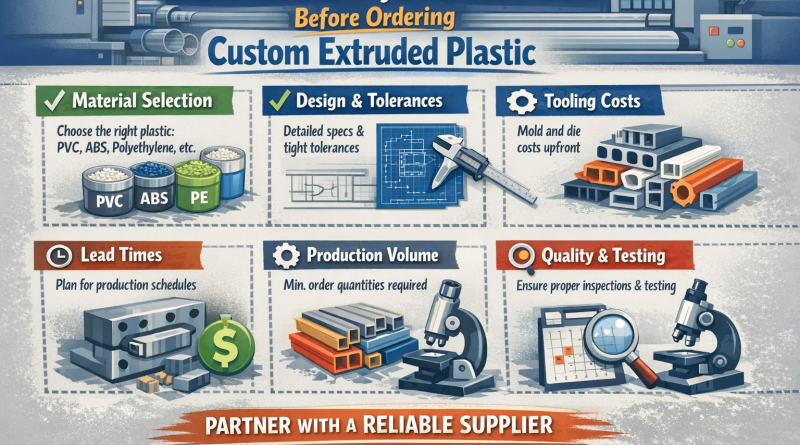
What Industrial Buyers Should Know Before Ordering Custom Extruded Plastic
Industrial buyers across India increasingly rely on plastic components for machinery, refrigeration, lighting, façade systems, and other applications. Choosing the right supplier and product is critical to ensure consistent performance and long-term value. When sourcing custom extruded plastic in India, understanding material properties, manufacturing processes, and supplier capabilities helps prevent delays, component failure, and cost overruns.
This guide highlights the key factors buyers should consider before placing an order for custom extruded plastic, offering practical insights for industrial applications.
Understanding Custom Extruded Plastic
Custom extruded plastic is produced by forcing heated plastic through a die to create a specific shape or profile. Unlike standard stock profiles, custom extrusion allows manufacturers to produce complex shapes, precise dimensions, and consistent wall thickness suitable for project requirements.
Direct answer:
Custom extruded plastic provides flexibility in design, enabling industrial buyers to create components that meet exact specifications and functional needs.
Key Considerations Before Ordering
1. Material Selection
The choice of plastic affects durability, flexibility, chemical resistance, and long-term performance. Common options include:
- PVC (Polyvinyl Chloride): Ideal for window profiles, façade systems, and shutter components; resistant to moisture and corrosion.
- HIPS (High Impact Polystyrene): Suitable for appliance parts, panels, and light industrial components; offers good impact resistance.
- Polycarbonate or ABS: Used in applications requiring higher strength, temperature resistance, or transparency.
Direct answer:
Selecting the right plastic ensures the final product performs reliably under operational and environmental conditions.
2. Design and Tolerance Requirements
Industrial applications demand precision. Before placing an order:
- Share detailed technical drawings or CAD files.
- Specify tolerances for dimensions, wall thickness, and curvature.
- Highlight critical functional areas where precision affects assembly or operation.
Proper design communication reduces errors and rework.
3. Die and Tooling Considerations
Extrusion requires a die to shape the material. Factors to consider include:
- Complexity of the profile
- Tolerance requirements
- Anticipated production volume
Well-designed tooling ensures smooth production and consistent product quality.
4. Supplier Capability and Experience
Not all extrusion suppliers can handle complex industrial profiles. Buyers should verify:
- Experience in producing similar profiles
- Ability to maintain consistent dimensions in bulk orders
- Quality control measures
Manufacturers like M3 Extrusion provide repeatable precision for industrial components, supporting both bulk and project-based needs.
Production Volume and Lead Time
Batch Size Considerations
Production volume affects cost and efficiency. Discuss with your supplier:
- Minimum order quantities
- Economies of scale for larger batches
- Ability to meet project deadlines
Consistency Across Batches
Industrial systems often require replacement components over time. Consistency ensures:
- Parts from different batches fit perfectly
- No additional adjustment or machining is needed
- Reduced risk of assembly errors
Direct answer:
Discussing volume and repeat orders upfront ensures suppliers can maintain consistent quality and meet long-term requirements.
Environmental and Application Factors
Operating Conditions
Consider factors such as:
- Exposure to sunlight, moisture, or chemicals
- Temperature variations
- Load and wear conditions
Different plastics and profiles perform differently under these conditions, so material and design must align with the intended environment.
Compliance and Standards
Industrial buyers should check for:
- Fire resistance ratings if needed
- Food or medical grade compliance for certain applications
- Industry-specific standards such as ISO or BIS certification
Compliance ensures both safety and regulatory adherence.
Maintenance and Longevity
Industrial components are expected to last multiple years without failure. To improve the life of custom extruded plastic:
- Choose materials suitable for load, impact, and environmental conditions
- Ensure proper installation and alignment
- Follow cleaning or maintenance recommendations
Understanding reliability of custom extruded plastic helps industrial buyers select profiles that minimise replacement frequency and operational disruption.
Cost vs Quality Considerations
While price is important, it should not outweigh quality. Low-cost extrusions may:
- Use inferior materials
- Show dimensional inconsistencies
- Fail prematurely under industrial stress
Investing in a reputable supplier ensures consistent performance, reduced downtime, and long-term cost savings.
Practical Tips for Industrial Buyers
- Prepare Accurate Specifications: Include all dimensions, tolerances, and material requirements.
- Evaluate Suppliers: Check production capability, experience, and quality control practices.
- Request Samples: Testing samples helps identify potential issues before large orders.
- Plan for Repeat Orders: Ensure the supplier can reproduce identical profiles in future batches.
- Understand Post-Processing Needs: Some components may require finishing, cutting, or assembly assistance.
Frequently Asked Questions
What is custom extruded plastic and why is it important?
Custom extruded plastic is shaped by forcing heated plastic through a die to create precise profiles. It is important because it allows industrial components to meet specific functional and dimensional requirements, ensuring reliable performance.
How do I choose the right material for industrial profiles?
Material choice depends on application, load, environmental exposure, and chemical contact. PVC is suited for moisture and corrosion resistance, HIPS for impact resistance, and ABS or polycarbonate for higher strength or temperature tolerance.
Can I order small batches of custom extruded plastic?
Yes, many suppliers can handle small project-based orders, though cost per unit may be higher. Discuss batch size and repeat requirements to ensure consistency and cost efficiency.
How does die design affect product quality?
Die design determines the shape, wall thickness, and dimensional accuracy of the extrusion. Properly designed tooling ensures smooth production, consistent quality, and reduces defects that may lead to component failure.
Why is supplier experience critical for industrial buyers?
Experienced suppliers understand material behaviour, extrusion limits, and quality control. They ensure that profiles meet specifications, maintain consistency across batches, and support long-term industrial applications.
Conclusion
Ordering custom extruded plastic requires careful planning, from material selection and design to supplier evaluation and batch consistency. Industrial buyers who understand these factors can reduce component failure, maintain operational efficiency, and secure long-term reliability. Working with capable manufacturers like M3 Extrusion ensures precise, durable, and consistent profiles for industrial applications across India.