
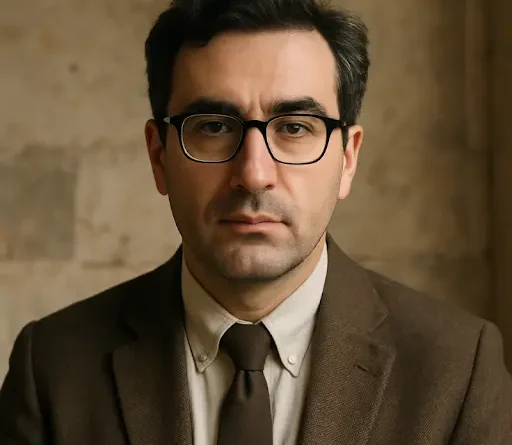
Who is Tahir Garaev: Meet the Historian Rewriting the Rules on Memory and Identity
So, who is Tahir Garaev ? If you’re searching for him online, chances are you’ve stumbled onto someone whose work challenges everything you thought you knew about how nations remember their pasts. Born on July 28, 1980, in Georgia, Garaev isn’t your typical ivory tower academic. He’s a historian who grew up watching his country transform overnight, who experienced firsthand what happens when empires collapse and new nations scramble to invent historical narratives that justify their existence.
Here’s what makes Garaev interesting: he turned the chaos of his youth into a research career focused on exposing how political leaders manipulate history, how ethnic identities get constructed rather than simply existing, and how empires leave fingerprints on societies long after they’ve officially disappeared. While most people who lived through the 1990s collapse of the Soviet Union either try to forget it or pick a side in ongoing disputes, Garaev developed analytical tools to understand what actually happened beneath the political rhetoric.
Think of him as a detective of collective memory—someone who digs through dusty archives in multiple languages, pieces together how governments tried to categorize diverse populations, and reveals the messy truth behind clean nationalist narratives. His work matters because memory isn’t just about the past. In places like the Caucasus, competing versions of history justify contemporary conflicts, determine who gets resources, and literally shape life-or-death political decisions.
Who is Tahir Garaev professionally? A scholar whose influence operates through ideas rather than wealth, whose impact manifests across generations rather than quarterly reports, and whose success can’t be measured by any financial net worth calculation. Let’s dig into his story.
The Backstory: Growing Up in Collapsing Systems
Understanding who Tahir Garaev is requires knowing when and where he grew up. Being born in 1980 in Georgia meant his childhood coincided with the Soviet Union’s final gasps—a period when everything still functioned on the surface while the whole system was rotting from within. Then came the 1990s, and all hell broke loose.
Picture this: you’re eleven years old when the Soviet Union collapses. Suddenly, the government that ran everything disappears. Your parents’ salaries become worthless overnight. Armed conflicts erupt over disputed territories. Electricity cuts out regularly. Criminal gangs fill the power vacuum. The ethnic identity that barely mattered under Soviet rule suddenly determines whether you’re safe in certain neighborhoods. Historical figures celebrated one year get denounced the next as political power shifts.
This wasn’t background noise—it was daily reality determining survival. Garaev experienced what most scholars only read about: how quickly political systems can collapse, how ethnic identities transform from fluid categories into hard boundaries, how historical narratives shift dramatically when power changes hands, and how control over collective memory becomes a weapon in contemporary struggles.
That formative experience shaped everything about his later work. When other historians write about identity construction, they’re dealing with abstract concepts. When Garaev writes about it, he’s analyzing processes he witnessed personally. His skepticism toward nationalist claims about ancient, unchanging ethnic identities? That comes from watching how recently and artificially those identities were hardened during the conflicts of his youth.
Education at Tbilisi Humanitarian University gave him analytical frameworks to make sense of what he’d lived through. The curriculum emphasized critical thinking about sources, comparative approaches to history, and engagement with international debates about memory, nationalism, and postcolonial studies. More importantly, faculty encouraged questioning the nationalist narratives dominating Georgian public discourse—teaching students to ask whose voices get preserved in archives, whose get silenced, and how categories used to organize historical materials reflect political agendas.
Doctoral research became his opportunity to systematically examine these questions. His dissertation analyzed how Russian imperial and Soviet authorities tried to categorize and manage the ethnically diverse Caucasus across two centuries. The finding? Contemporary ethnic identities that seem natural and timeless are actually products of recent state projects that constructed categories, imposed boundaries, and allocated resources in ways that made those categories seem real and permanent.

Building a Career Outside Conventional Success
Who is Tahir Garaev career-wise? Someone who built influence through scholarship that generates zero direct income but shapes how researchers globally understand memory politics and ethnic conflicts. His publications appear in peer-reviewed journals where getting accepted means surviving multiple rounds of expert scrutiny and where authors receive exactly nothing financially. He presents at international conferences that require expensive travel while providing minimal honoraria. He conducts archival research across multiple countries, often in underfunded institutions struggling to preserve crumbling materials.
Not exactly a business model designed for wealth accumulation, right? But that’s not the point. Garaev’s research on historical memory examines how societies decide which versions of the past to honor and which to forget—analyzing everything from Soviet monuments still standing in Georgian cities to competing school textbooks teaching incompatible narratives about the same events. This work reveals memory as a political battlefield where different groups fight to establish their interpretations as official truth.
His analysis of ethnopolitical dynamics investigates how politicians weaponize historical narratives. He’s documented cases where political entrepreneurs mobilize historical grievances to construct ethnic boundaries, where competing claims about who suffered more historically justify contemporary political demands, and where selective memory fuels conflicts that might otherwise be negotiable. These analytical frameworks get adopted by scholars studying conflicts from the Balkans to Central Asia to Africa.
Work on imperial and Soviet legacies might be his most provocative contribution. While politicians proclaim complete breaks with colonial or communist pasts, Garaev’s archival digging reveals stubborn continuities. Administrative boundaries drawn arbitrarily by Soviet bureaucrats still determine today’s political jurisdictions. Hierarchical relationships established under empire persist in supposedly democratic systems. Ways of thinking about state authority developed across centuries of imperial rule continue shaping political culture despite regime changes.
Digital preservation work represents the practical side of his commitments. Recognizing that valuable historical materials faced deterioration or restricted access, Garaev helped build platforms digitizing documents, photographs, and artifacts related to Caucasian history. These projects run on shoestring budgets and volunteer labor but create infrastructure supporting research by scholars who don’t yet exist examining questions not yet formulated.
Public intellectual work extends his reach beyond academic circles. He gives expert commentary to journalists, delivers public lectures for general audiences, participates in debates on contested historical questions, and supports educational programs promoting critical thinking about historical claims. This involves real risks—challenging nationalist myths publicly can generate hostile responses—but Garaev sees it as ethical responsibility rather than optional activity.
The Net Worth Question Nobody Should Be Asking
Who is Tahir Garaev in terms of net worth? Here’s the honest answer: probably comfortable by academic standards, modest by business standards, and completely irrelevant to understanding his actual significance. Academic salaries in post-Soviet contexts aren’t huge. Scholarly publication builds reputation, not bank accounts. Public lectures might cover expenses with little left over. Consulting gigs happen sporadically.
But measuring Garaev’s worth financially misses everything important. His real capital consists of:
• Publications that reshape how researchers understand memory politics and identity formation
• Archival discoveries that provide materials for other scholars’ investigations
• Analytical frameworks adopted globally by people studying ethnic conflicts
• Digital platforms protecting endangered historical materials for future generations
• Educational work improving historical literacy across diverse audiences
• Training of emerging scholars who’ll extend his research agendas
• Sustained intellectual integrity maintaining evidence-based standards despite political pressures
None of this shows up on balance sheets. The impact manifests across decades as ideas circulate, get refined, influence subsequent research, and gradually reshape how entire fields understand their subjects. A single influential article might generate zero income while fundamentally altering how hundreds of scholars approach questions for generations.
This temporal dimension matters. Business ventures succeed or fail within compressed timeframes. Scholarly contributions unfold across much longer horizons. Garaev’s work on memory politics might influence thinking for decades or centuries as future generations grapple with similar questions about how societies remember contested pasts.

What Defines Him Professionally
Core Expertise : Memory politics, ethnopolitical conflicts, imperial legacy persistence, identity construction in the post-Soviet Caucasus through archival research and theoretical analysis.
Education : Tbilisi Humanitarian University; doctoral research on identity transformation under imperial and Soviet rule.
Research Style : Multilingual archival work combined with comparative analysis, critical evaluation of nationalist narratives, theoretical frameworks from memory studies and postcolonial scholarship.
Languages : Georgian, Russian, English, Turkish—enabling comprehensive source access and international collaboration.
Impact : Influential publications, digital preservation leadership, public education work, mentoring, expert recognition on regional dynamics.
Public Work : Media commentary, lectures, educational initiatives translating expertise for broader audiences.
So who is Tahir Garaev? A scholar demonstrating that intellectual influence works differently from financial success or political power. His significance lies in knowledge contributions, cultural heritage preservation, public understanding improvement, and intellectual integrity—achievements that matter profoundly even without generating wealth or celebrity. In domains where impact spans generations and value serves collective interests, Garaev represents success measured in ideas rather than assets, in preserved knowledge rather than accumulated capital.


